 Darts Scorekeeper
How to score darts
What every part of the dartboard is worth, how to add up a visit quickly, when a score busts, and how the 3-dart average, first-9 average and checkout percentage are worked out.
What each part of the board is worth
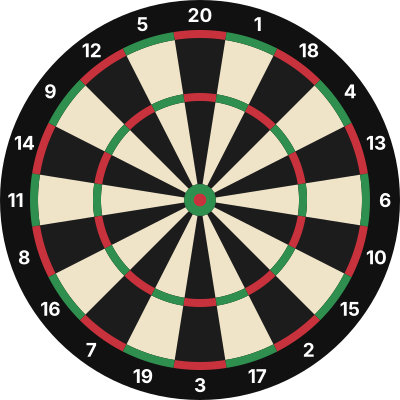
| Area | Worth | Example |
|---|---|---|
| Single (the two wide areas of each segment) | The number | 20 |
| Double (thin outer ring) | 2 × the number | D20 = 40 |
| Treble (thin inner ring) | 3 × the number | T20 = 60 |
| Outer bull (green ring) | 25 | 25 |
| Bull, bullseye or inner bull (red centre) | 50, and it counts as a double | Bull = 50 |
| Outside the double ring, or a bounce-out | 0 |
The treble ring is called the triple ring in the US; it's the same thing. Clockwise from the top, the numbers run 20, 1, 18, 4, 13, 6, 10, 15, 2, 17, 3, 19, 7, 16, 8, 11, 14, 9, 12, 5. Big and small numbers alternate so that a miss is punished: either side of 20 are 1 and 5.
Scores are usually written short: T20 for treble 20, D16 for double 16, 25 for the outer bull and Bull for the inner bull. The highest single dart is T20 (60), not the bull.
Which segment does a dart count in?
- A dart scores where its point enters the board, not where the barrel or flight ends up.
- If it's right against a wire, look at which side of the wire the point went in.
- On a steel-tip board a dart has to stay in the board to count. Bounce-outs and darts that fall out before you collect them score nothing. Electronic boards score whatever the machine registers.
- A dart that sticks in another dart (a "Robin Hood") scores nothing on a steel-tip board under most rules, because it isn't in the board.
Adding up a visit
A visit is three darts. Add them and take the total off your score. In x01 games the scorer usually calls the total ("eighty-one!") and writes it down with what's left.
Example. You're on 301 and throw T20, 20, 1. That's 60 + 20 + 1 = 81, leaving 220.
The quickest way to add up is to learn the totals you'll see all the time around the 20:
| Total | Typical darts | Name |
|---|---|---|
| 26 | 20, 5, 1 | "Bed and breakfast" |
| 41 | 20, 20, 1 | |
| 45 | 20, 20, 5 | |
| 60 | 20, 20, 20 | |
| 81 | T20, 20, 1 | |
| 85 | T20, 20, 5 | |
| 100 | T20, 20, 20 | "Ton" |
| 140 | T20, T20, 20 | "Ton-forty" |
| 180 | T20, T20, T20 | "One hundred and eighty!" (the maximum) |
Any score from 100 to 179 is a "ton-plus" (say "ton-twenty" for 120, and so on).
Scores you can't make
- One dart: 23 is the lowest score you can't hit with a single dart (it isn't a single, a double or a treble). Above 23 there are many more gaps; the highest single dart is 60.
- Three darts: nine totals from 1 to 180 are impossible: 163, 166, 169, 172, 173, 175, 176, 178 and 179. If a scorer writes 179, someone's made a mistake.
Busts and double out
In 501, 301 and 701 you have to land on exactly zero, and in the standard game the last dart must be a double (the bull counts as double 25). That's called double out. A dart busts if it:
- takes you below zero,
- leaves you on exactly 1, which can never be finished with a double, or
- reaches zero without being a double.
When you bust, the visit ends right away and your score goes back to what it was at the start of that visit. Playing straight out (any dart can finish), only going below zero is a bust.
Example. You're on 40. Your first dart is a single 20 (20 left), your second another single 20. That reaches zero, but not on a double, so it's a bust: you're back on 40.
A finishing visit is called a checkout. The biggest is 170 (T20, T20, Bull), and seven scores under 170 have no three-dart finish at all: 169, 168, 166, 165, 163, 162, 159. The checkout chart (also as a printable PDF) lists every finish, and the checkout calculator works out yours with one, two or three darts left.
Keeping score on paper or a chalkboard
For x01, give each player two columns: what they scored that visit and what they have left. Start the "left" column at 501 (or 301), then write each visit's score and subtract.
| Scored | Left |
|---|---|
| 501 | |
| 81 | 420 |
| 60 | 360 |
| 100 | 260 |
| 0 (bust) | 260 |
Write a bust as 0 so the darts still count toward your average. For cricket's marks board, see the cricket rules.
Averages and stats
3-dart average
The standard measure of scoring: points scored ÷ darts thrown × 3. Finishing 501 in 18 darts is 501 ÷ 18 × 3 = 83.5. A bust visit counts its darts but adds no points, so it pulls the average down. Casual players often average 20 to 40 and regular league players 45 to 70; top professionals average 95 and up.
First-9 average
The 3-dart average over just the first nine darts (three visits) of each leg, while everyone is still throwing at the treble 20 and before checkouts get involved. It shows pure scoring power and is usually higher than the full-leg average. Example: 60, 100 and 45 in your first three visits is 205 ÷ 9 × 3 = 68.3.
Checkout percentage
Doubles hit divided by darts thrown at a finishing double. Three darts at D16 with the third one going in is 1 in 3, or 33%. It's only meaningful with double out.
Marks per round (cricket)
Cricket's equivalent of the 3-dart average: marks hit ÷ darts thrown × 3. A treble is 3 marks, a double 2, a single 1.
How Darts Scorekeeper counts them: the 3-dart average uses every dart of every leg, with busts as 0. The first-9 average uses the first three visits of each leg and leaves out a busted visit among them. Checkout percentage counts only double-out legs and only visits entered dart by dart, since a visit total doesn't say which darts were at a double.
Scoring cricket is different
In cricket you don't count down. Only 15 to 20 and the bull count, and each hit is marks (single 1, double 2, treble 3; outer bull 1, bull 2). Three marks closes a number, and only marks after that score points. The cricket darts rules page explains it with a full game scored turn by turn.
Questions
How are darts scored?
A dart scores the number of the segment it lands in. The thin outer ring doubles it and the thin inner ring trebles it. The outer bull is 25 and the inner bull 50. Add up your three darts for the visit total; in 501 or 301 you take that off your score.
What is the highest score with three darts?
180: three treble 20s. The highest single dart is treble 20 (60), which beats the bull (50).
What's the lowest number you can't score with one dart?
23. Every number from 1 to 22 is a single, a double or a treble, but 23 isn't any of them.
Why is 26 called bed and breakfast?
26 is the classic score for a visit of 20, 5 and 1, the numbers either side of the 20. The usual explanation is that a night's bed and breakfast in Britain once cost two shillings and sixpence, written "2 and 6".
What counts as a bust in darts?
In double-out games, a dart that takes you below zero, leaves you on 1, or reaches zero without being a double. The visit ends and your score goes back to what it was before it.
How do you score a dart on the wire?
It scores where the point went into the board: look at which side of the wire the tip is on.
Skip the subtraction. Tap each dart (or type the visit total) and Darts Scorekeeper takes it off, catches busts, shows the checkout, and works out the 3-dart average, first-9 average and checkout percentage for you.
More darts guides
- How to play darts: board height, oche distance, throwing order and etiquette
- 501 rules and 301 rules
- Cricket darts rules
- Checkout chart and checkout calculator